Jezz Blog's

Philippines
Country in Asia
Description
The Philippines, officially the Republic of the Philippines, is an archipelagic country in Southeast Asia. Situated in the western Pacific Ocean, it consists of about 7,641 islands that are broadly categorized under three main geographical divisions from north to south: Luzon, Visayas, Mindanao.
TRADITIONS:quirky Filipino New Year traditions- Wear polka dots dress. ...
- Jumping high when the clock strikes 12. ...
- Media Noche. ...
- A variety of round-shaped fruits. ...
- Eat sticky rice to strengthen family bond. ...
- Eat pancit (noodles) for long life and fortune. ...
- No chicken and fish dishes. ...
- Water and rice container should be full.
CLOTHING:
 Baro't Saya (literally "Shirt and Skirt") is the Filipino style of women's clothing. Traditionally, it is composed of a blouse and a long skirt with a "panuelo". It evolved many variants, some are regional. The upper-class women wore more elaborate baro't saya sewn with beads and has colorful designs.
LANGUAGE:About
- Wear polka dots dress. ...
- Jumping high when the clock strikes 12. ...
- Media Noche. ...
- A variety of round-shaped fruits. ...
- Eat sticky rice to strengthen family bond. ...
- Eat pancit (noodles) for long life and fortune. ...
- No chicken and fish dishes. ...
- Water and rice container should be full.
Description
Filipino, also known as Pilipino, is the national language of the Philippines. Filipino is also designated, along with English, as an official language of the country. It is a standardized variety of the Tagalog language, an Austronesian regional language that is widely spoken in the Philippines.
SOCIAL HABITS:
Being Respectful to the Elderly
It’s a tradition rooted from the early days. As a way of courtesy and showing respect, younger people use the Filipino words “opo” to agree with the elderly. And, they insert “po” at the end of a phrase or sentence when talking to someone older than him or her.
Aside from saying “po” and “opo,” Filipinos also show courtesy by calling older persons “ate” (sister) or “kuya” (brother) even if there’s no blood relation between them. In some familiar situations, Filipinos bow their heads and press their foreheads toward the hand of the elder as a sign of respect.
MUSIC:
 The traditional music of the Philippines, like the folk music of other countries, reflects the life of common, mostly rural Filipinos. Like their counterparts in Asia, many traditional songs from the Philippines have a strong connection with nature. However, much of it[vague] employs the diatonic scale rather than the "more Asian" pentatonic scale, with the exception of indigenous people itual music.[editorializing]
CUISINE:
It’s a tradition rooted from the early days. As a way of courtesy and showing respect, younger people use the Filipino words “opo” to agree with the elderly. And, they insert “po” at the end of a phrase or sentence when talking to someone older than him or her.
Aside from saying “po” and “opo,” Filipinos also show courtesy by calling older persons “ate” (sister) or “kuya” (brother) even if there’s no blood relation between them. In some familiar situations, Filipinos bow their heads and press their foreheads toward the hand of the elder as a sign of respect.
MUSIC:
Lechon
One of the top contenders among the best Filipino dishes (alongside adobo) is perhaps the famous lechon. After all, it is hard to top a tasty, fully-roasted pig with perfectly crisp skin and juicy meat. Find the best of this sinful treat on the island of Cebu, but this is almost always served at any grand Pinoy gathering or fiesta.
' x='0' y='0' height='100%25' width='100%25' xlink%3Ahref='data%3Aimage/jpeg;base64,/9j/4AAQSkZJRgABAQAAAQABAAD/2wBDABALDA4MChAODQ4SERATGCgaGBYWGDEjJR0oOjM9PDkzODdASFxOQERXRTc4UG1RV19iZ2hnPk1xeXBkeFxlZ2P/2wBDARESEhgVGC8aGi9jQjhCY2NjY2NjY2NjY2NjY2NjY2NjY2NjY2NjY2NjY2NjY2NjY2NjY2NjY2NjY2NjY2NjY2P/wAARCAAGAAkDASIAAhEBAxEB/8QAFQABAQAAAAAAAAAAAAAAAAAAAAP/xAAcEAEAAQQDAAAAAAAAAAAAAAACAAEDBBETIVH/xAAUAQEAAAAAAAAAAAAAAAAAAAAC/8QAFxEBAQEBAAAAAAAAAAAAAAAAAQAhMf/aAAwDAQACEQMRAD8AG0MnHtpmm3TqS4T4YiE6zXC//9k='%3E%3C/image%3E%3C/svg%3E)

Lechon being roasted over charcoal | © Whologwhy / Flickr
One of the top contenders among the best Filipino dishes (alongside adobo) is perhaps the famous lechon. After all, it is hard to top a tasty, fully-roasted pig with perfectly crisp skin and juicy meat. Find the best of this sinful treat on the island of Cebu, but this is almost always served at any grand Pinoy gathering or fiesta.
Adobo
It’s the Filipino dish everybody knows — the mighty adobo. It is made by stewing meat (usually chicken, pork, or a combination of both) in soy sauce and vinegar, adding peppercorns and bay leaves for that special flavour. Bonus leftovers tip: pull the meat from the bone and fry ’til crispy for some tasty adobo flakes.
' x='0' y='0' height='100%25' width='100%25' xlink%3Ahref='data%3Aimage/jpeg;base64,/9j/4AAQSkZJRgABAQAAAQABAAD/2wBDABALDA4MChAODQ4SERATGCgaGBYWGDEjJR0oOjM9PDkzODdASFxOQERXRTc4UG1RV19iZ2hnPk1xeXBkeFxlZ2P/2wBDARESEhgVGC8aGi9jQjhCY2NjY2NjY2NjY2NjY2NjY2NjY2NjY2NjY2NjY2NjY2NjY2NjY2NjY2NjY2NjY2NjY2P/wAARCAAGAAgDASIAAhEBAxEB/8QAFQABAQAAAAAAAAAAAAAAAAAAAAX/xAAeEAABBAEFAAAAAAAAAAAAAAACAAEDEQQFISIxQf/EABUBAQEAAAAAAAAAAAAAAAAAAAID/8QAFxEAAwEAAAAAAAAAAAAAAAAAAAEhAv/aAAwDAQACEQMRAD8Am6e+HPE8Z44kLDsBA3XnK7tERR1HBI//2Q=='%3E%3C/image%3E%3C/svg%3E)

At least 92% of the population is Christian; about 81% belong to the Catholic Church while about 11% belong to Protestantism, Orthodoxy, Restorationist and Independent Catholicism and other denominations such as Iglesia Filipina Independiente, Iglesia ni Cristo, Seventh-day Adventist Church, United Church of Christ in .

Germany
Description
Germany is a Western European country with a landscape of forests, rivers, mountain ranges and North Sea beaches. It has over 2 millennia of history. Berlin, its capital, is home to art and nightlife scenes, the Brandenburg Gate and many sites relating to WWII. Munich is known for its Oktoberfest and beer halls, including the 16th-century Hofbräuhaus. Frankfurt, with its skyscrapers, houses the central bank.
 Authentic German Traditions
- Schultüte on the first day of school. The Schultüte is a tradition that was established during the 19th century. ...
- Fireworks on New Year's Eve. ...
- Watching 'Dinner For One' on New Year's Eve. ...
- Reinfeiern. ...
- Karneval. ...
- Tanz in den Mai. ...
- Tanzverbot. ...
- Tatort.


A dirndl consists of a close-fitting bodice featuring a low neckline, a blouse worn under the bodice, a wide high-waisted skirt and an apron. The dirndl is regarded as a folk costume (in German Tracht).
 The official language of Germany is German, with over 95% of the population speaking German as their first language. Minority languages include Sorbian, spoken by 0.09% in the east of Germany and North Frisian spoken in Nordfriesland by around 10,000 people, or 0.01%, who also speak German.
SOCIAL HABITS:7 German habits we should all adopt- Leave empty bottles on the streets. In German, empty bottles = money. ...
- Sit when you pee – even if you're a man. My favorite unusual habit so far. ...
- Drinking warm beer. ...
- RV, RV and more RV. ...
- Cash only. ...
- Rent for life. ...
- Pretending it is warm. / pretending it is cold.
MUSIC:
 German musicians have also made a noticeable mark on world culture.
- Classical Music: The Three Bs.
- Popular Music: Cabaret, Swing, & Theatre.
- Music of the People: Folk Music and Schlager.
- German-Language Music: Pop, Neue Deutsche Welle, and Hamburger Schule.
- Electronic Music: Krautrock and Techno.
- Hip Hop.

 The cuisine of Germany is made up of many different local or regional cuisines, as is typical for somewhat larger countries. Germany itself is part of a larger cultural region, Central Europe, sharing many traditions with neighbouring countries such as Poland and the Czech Republic.
 The main religion in Germany is Christianity, with around two-thirds of the population identifying as Christian. The number that actively practices Christianity in the form of church attendance, however, is significantly lower.
 Brazil, officially the Federative Republic of Brazil, is the largest country in both South America and Latin America. At 8.5 million square kilometers and with over 211 million people, Brazil is the world's fifth-largest country by area and the sixth most populous.
 Much of Brazil's international reputation is centered around local traditions and celebrations such as capoeira, the national sport, and the festivities of Carnaval. From the cult of soccer to Catholic holidays to the rituals of the local religion, Candomble, Brazil's traditions are both secular and sacred.
LANGUANGE:PortugueseMinority languages. Despite the fact that Portuguese is the official language of Brazil and the vast majority of Brazilians speak only Portuguese, there are several other languages spoken in the country.
- Schultüte on the first day of school. The Schultüte is a tradition that was established during the 19th century. ...
- Fireworks on New Year's Eve. ...
- Watching 'Dinner For One' on New Year's Eve. ...
- Reinfeiern. ...
- Karneval. ...
- Tanz in den Mai. ...
- Tanzverbot. ...
- Tatort.
- Leave empty bottles on the streets. In German, empty bottles = money. ...
- Sit when you pee – even if you're a man. My favorite unusual habit so far. ...
- Drinking warm beer. ...
- RV, RV and more RV. ...
- Cash only. ...
- Rent for life. ...
- Pretending it is warm. / pretending it is cold.
- Classical Music: The Three Bs.
- Popular Music: Cabaret, Swing, & Theatre.
- Music of the People: Folk Music and Schlager.
- German-Language Music: Pop, Neue Deutsche Welle, and Hamburger Schule.
- Electronic Music: Krautrock and Techno.
- Hip Hop.
01 OCT

Every culture is different from the other and we should all respect that. However, we can’t help but notice some habits that are not similar to the ones we are used to. In Brazil, for instance, people are very affectionate, even with people they do not know. That may cause some hesitation for foreigners who are not used to have physical contact with strangers.
Brazilian culture shares many similarities with other Latin countries. However, some Brazilian habits are very unusual for foreigners from North America, Asia, and Europe.
Let’s check a few Brazilian habits foreigners may find to be weird:
Every culture is different from the other and we should all respect that. However, we can’t help but notice some habits that are not similar to the ones we are used to. In Brazil, for instance, people are very affectionate, even with people they do not know. That may cause some hesitation for foreigners who are not used to have physical contact with strangers.
Brazilian culture shares many similarities with other Latin countries. However, some Brazilian habits are very unusual for foreigners from North America, Asia, and Europe.
Let’s check a few Brazilian habits foreigners may find to be weird:
Brushing teeth at work
Dentists say you should brush your teeth after every meal. And Brazilians do follow this rule, no questions asked. It is not unusual to see Brazilians bringing their toothbrush to work. They usually brush their teeth after lunch and continue with their day with a healthy and clean smile. If you work in Brazil, you have already probably seen people brushing their teeth in the workplace bathroom. Sometimes Brazilian brush their teeth even in the shopping mall restroom facilities.
 Music is one of the cornerstones of Brazil; genres like samba are synonymous with Brazilian culture. The remarkable aspect of Brazilian music is that so many genres are unique to the nation – bossa nova, samba, and sertanejo to name just a few. As well as their own unique beats, some Brazilian musicians have borrowed other genres – rap and pop for instance – and molded them into something distinctly Brazilian.
 Brazilian cuisine is the set of cooking practices and traditions of Brazil, and is characterized by European, Amerindian, African, and most recently Asian influences. It varies greatly by region, reflecting the country's mix of native and immigrant populations, and its continental size as well.
 CatholicismBrazil has the largest number of Catholic Christians in the world. Catholicism has been Brazil's main religion since the beginning of the 16th century. It was introduced among the Native Brazilians by Jesuits missionaries and also observed by all the Portuguese first settlers.

Dentists say you should brush your teeth after every meal. And Brazilians do follow this rule, no questions asked. It is not unusual to see Brazilians bringing their toothbrush to work. They usually brush their teeth after lunch and continue with their day with a healthy and clean smile. If you work in Brazil, you have already probably seen people brushing their teeth in the workplace bathroom. Sometimes Brazilian brush their teeth even in the shopping mall restroom facilities.
Thailand
Country in Asia
Description
Thailand is a Southeast Asian country. It's known for tropical beaches, opulent royal palaces, ancient ruins and ornate temples displaying figures of Buddha. In Bangkok, the capital, an ultramodern cityscape rises next to quiet canalside communities and the iconic temples of Wat Arun, Wat Pho and the Emerald Buddha Temple (Wat Phra Kaew). Nearby beach resorts include bustling Pattaya and fashionable Hua Hin
 Thailand festivals, cultures, traditions and how to experience them
- Rockets For Rain – Rocket Festival (Bun Bang Fai) ...
- Light Up The Night Sky – Chiang Mai Yi Peng Lantern Festival. ...
- Great Balls of Fire! – ...
- Not For The Squeamish – Vegetarian Festival. ...
- An Ancient Culture Under Threat – The Mon People of Thailand.
-
 Traditional Thai clothing is called chut thai, which literally means 'Thai outfit'. It can be worn by men, women, and children. Chut thai for women usually consists of a pha nung or a pha chung hang, a blouse, and a pha biang.
- LANGUAGE:Thai language, also called Siamese, the standard spoken and literary language of Thailand, belonging to the Tai language family of Southeast Asia
- SOCIAL HABITS:
- Strange Thai Behavior.
- Thai's Accept Gifts From Others Without Opening Them. ...
- Throwing Trash Out Of A Moving Vehicle. ...
- Thais Put Ice In Their Drinks When They Are Feeling Cold. ...
- Set The Air Conditioner On The Lowest Possible Setting. ...
- Skin Whitening Phenomenon. ...
- Sunbathing With Clothes On. ...
- Thai's Love Stinky Food.
 The two most popular styles of traditional Thai music are luk thung and mor lam; the latter in particular has close affinities with the music of Laos. Aside from the Thai, ethnic minorities such as the Lao, Lawa, Hmong, Akha, Khmer, Lisu, Karen and Lahu peoples have retained traditional musical forms.
 Thai cuisine is the national cuisine of Thailand. Thai cooking places emphasis on lightly prepared dishes with strong aromatic components and a spicy edge.
 However, Buddhism is the most common Thailand religion with approximately 95% of the population following this Theravada religion. The remaining population follows the Muslim religion (4.6%), Catholic Christians (0.7%) with the remaining 1% divided between Hindu, Sikh and Jewish religions.
 Australia, officially the Commonwealth of Australia, is a sovereign country comprising the mainland of the Australian continent, the island of Tasmania, and numerous smaller islands. It is the largest country in Oceania and the world's sixth-largest country by total area.
 The culture of Australia is primarily a Western culture, to some extent derived from Britain but also influenced by the unique geography of Australia, the cultural input of Aboriginal, Torres Strait Islander and other Australian people. LANGUAGE: Most people who know much about Australia will know that the country has no national language as such, but English has since the time of European settlement been adopted as the de facto national language. SOCIAL HABITS: Australians are generally not formal, so greetings, even initial greetings, are casual and laid back. It's common to shake hands and Australians would normally just use first names to introduce people. Gifts are exchanged at birthdays and Christmas as they are in the UK.
 Australian folk music is the traditional music from the large variety of immigrant cultures and those of the original Australian inhabitants.
 Cover to Banjo Paterson's seminal 1905 collection of bush ballads, entitled The Old Bush Songs
Celtic, English, German and Scandinavian folk traditions predominated in the first wave of European immigrant music. The Australian tradition is, in this sense, related to the traditions of other countries with similar ethnic, historical and political origins, such as New Zealand, Canada and the United States.
 Australian cuisine refers to the food and cooking practices of Australia and its inhabitants. As a modern nation of large-scale immigration, Australia has a unique blend of culinary contributions and adaptations from various cultures around the world, including British, European, Asian and Middle Eastern.
 The 2016 census identified that 52.1% of Australians classify themselves Christian: 22.6% identifying themselves as Catholic and 13.3% as Anglican. Another 8.2% of Australians identify themselves as followers of non-Christian religions.
-
- Rockets For Rain – Rocket Festival (Bun Bang Fai) ...
- Light Up The Night Sky – Chiang Mai Yi Peng Lantern Festival. ...
- Great Balls of Fire! – ...
- Not For The Squeamish – Vegetarian Festival. ...
- An Ancient Culture Under Threat – The Mon People of Thailand.
- Traditional Thai clothing is called chut thai, which literally means 'Thai outfit'. It can be worn by men, women, and children. Chut thai for women usually consists of a pha nung or a pha chung hang, a blouse, and a pha biang.
- LANGUAGE:Thai language, also called Siamese, the standard spoken and literary language of Thailand, belonging to the Tai language family of Southeast Asia
- SOCIAL HABITS:
- Strange Thai Behavior.
- Thai's Accept Gifts From Others Without Opening Them. ...
- Throwing Trash Out Of A Moving Vehicle. ...
- Thais Put Ice In Their Drinks When They Are Feeling Cold. ...
- Set The Air Conditioner On The Lowest Possible Setting. ...
- Skin Whitening Phenomenon. ...
- Sunbathing With Clothes On. ...
- Thai's Love Stinky Food.
The two most popular styles of traditional Thai music are luk thung and mor lam; the latter in particular has close affinities with the music of Laos. Aside from the Thai, ethnic minorities such as the Lao, Lawa, Hmong, Akha, Khmer, Lisu, Karen and Lahu peoples have retained traditional musical forms.
Thai cuisine is the national cuisine of Thailand. Thai cooking places emphasis on lightly prepared dishes with strong aromatic components and a spicy edge.
However, Buddhism is the most common Thailand religion with approximately 95% of the population following this Theravada religion. The remaining population follows the Muslim religion (4.6%), Catholic Christians (0.7%) with the remaining 1% divided between Hindu, Sikh and Jewish religions.
Australia, officially the Commonwealth of Australia, is a sovereign country comprising the mainland of the Australian continent, the island of Tasmania, and numerous smaller islands. It is the largest country in Oceania and the world's sixth-largest country by total area.
The culture of Australia is primarily a Western culture, to some extent derived from Britain but also influenced by the unique geography of Australia, the cultural input of Aboriginal, Torres Strait Islander and other Australian people. LANGUAGE: Most people who know much about Australia will know that the country has no national language as such, but English has since the time of European settlement been adopted as the de facto national language. SOCIAL HABITS: Australians are generally not formal, so greetings, even initial greetings, are casual and laid back. It's common to shake hands and Australians would normally just use first names to introduce people. Gifts are exchanged at birthdays and Christmas as they are in the UK. Australian folk music is the traditional music from the large variety of immigrant cultures and those of the original Australian inhabitants.
Cover to Banjo Paterson's seminal 1905 collection of bush ballads, entitled The Old Bush SongsCeltic, English, German and Scandinavian folk traditions predominated in the first wave of European immigrant music. The Australian tradition is, in this sense, related to the traditions of other countries with similar ethnic, historical and political origins, such as New Zealand, Canada and the United States.
Australian cuisine refers to the food and cooking practices of Australia and its inhabitants. As a modern nation of large-scale immigration, Australia has a unique blend of culinary contributions and adaptations from various cultures around the world, including British, European, Asian and Middle Eastern.
The 2016 census identified that 52.1% of Australians classify themselves Christian: 22.6% identifying themselves as Catholic and 13.3% as Anglican. Another 8.2% of Australians identify themselves as followers of non-Christian religions.

Egypt
- Country
- Country
Description
- Egypt, a country linking northeast Africa with the Middle East, dates to the time of the pharaohs. Millennia-old monuments sit along the fertile Nile River Valley, including Giza's colossal Pyramids and Great Sphinx as well as Luxor's hieroglyph-lined Karnak Temple and Valley of the Kings tombs. The capital, Cairo, is home to Ottoman landmarks like Muhammad Ali Mosque and the Egyptian Museum, a trove of antiquities.
- TRADITIONS: Egypt has impressed the world with its breathtaking attractions and unique touristic places—the country even has two of the world’s Seven Wonders; nevertheless, some of the Egyptian traditions are more astonishing and harder to understand their meaning than most of these wonders. Here are some of the top traditions only Egyptians can understan.
-
 The Ancient Egyptians wore clothing made from linen. Linen is a light and cool fabric that worked well in the hot climate of Egypt. ... Wealthy people wore very soft linen clothes made from thin fibers. Poor people and peasants wore rougher linen clothing made from thicker fibers. LANGUAGE:
Egyptian 


r n km.t[1]
ϯⲙⲉⲧⲣⲉⲙⲛ̀ⲭⲏⲙⲓ (Coptic)Region Originally, throughout Ancient Egypt and parts of Nubia; (especially, during the times of the Nubian kingdoms);[2] now, only, in several parts of Cairo[3] and several villages, in Upper Egypt[4][5][6]
SOCIAL HABITS: Egyptians are religious people. Most of the inhabitants of the country profess Islam, therefore life in Egypt is based on Muslim dogmas. Once the muezzin's singing is heard from the top of the minaret, believers drop everything and go to pray. The hot climate has defined the second main feature of the Egyptians' national character - calmness. People in Egypt do not like to be in a hurry. That's why they are often late and spend a lot of time for making decisions. Non-punctuality and slowness are justified by the habit of living by the "Egyptian time". Egyptians' favorite word is "Bukra", which means "tomorrow". They rarely refuse, but do not hesitate to repeatedly move an appointment to a later date and postpone the fulfillment of the promised.
- Egypt, a country linking northeast Africa with the Middle East, dates to the time of the pharaohs. Millennia-old monuments sit along the fertile Nile River Valley, including Giza's colossal Pyramids and Great Sphinx as well as Luxor's hieroglyph-lined Karnak Temple and Valley of the Kings tombs. The capital, Cairo, is home to Ottoman landmarks like Muhammad Ali Mosque and the Egyptian Museum, a trove of antiquities.
- TRADITIONS: Egypt has impressed the world with its breathtaking attractions and unique touristic places—the country even has two of the world’s Seven Wonders; nevertheless, some of the Egyptian traditions are more astonishing and harder to understand their meaning than most of these wonders. Here are some of the top traditions only Egyptians can understan.
- The Ancient Egyptians wore clothing made from linen. Linen is a light and cool fabric that worked well in the hot climate of Egypt. ... Wealthy people wore very soft linen clothes made from thin fibers. Poor people and peasants wore rougher linen clothing made from thicker fibers. LANGUAGE:
Egyptian r n km.t[1]
ϯⲙⲉⲧⲣⲉⲙⲛ̀ⲭⲏⲙⲓ (Coptic)Region Originally, throughout Ancient Egypt and parts of Nubia; (especially, during the times of the Nubian kingdoms);[2] now, only, in several parts of Cairo[3] and several villages, in Upper Egypt[4][5][6]
SOCIAL HABITS: Egyptians are religious people. Most of the inhabitants of the country profess Islam, therefore life in Egypt is based on Muslim dogmas. Once the muezzin's singing is heard from the top of the minaret, believers drop everything and go to pray. The hot climate has defined the second main feature of the Egyptians' national character - calmness. People in Egypt do not like to be in a hurry. That's why they are often late and spend a lot of time for making decisions. Non-punctuality and slowness are justified by the habit of living by the "Egyptian time". Egyptians' favorite word is "Bukra", which means "tomorrow". They rarely refuse, but do not hesitate to repeatedly move an appointment to a later date and postpone the fulfillment of the promised.
Music of Egypt
Music has been an integral part of Egyptian culture since antiquity. The Bible documents the instruments played by the ancient Hebrews, all of which are correlated in Egyptian archaeology. Egyptian music probably had a significant impact on the development of ancient Greek music, and via the Greeks was important to early European music well into the Middle Ages. Egyptian modern music is considered as a main core of Middle Eastern and Oriental music as it has a very big influence on the region due to the popularity and huge influence of Egyptian Cinema and Music industries. The tonal structure of Oriental Middle Eastern music is defined by the maqamat, loosely similar to the Western modes, while the rhythm of Middle Eastern music is governed by the iqa'at, standard rhythmic modes formed by combinations of accented and unaccented beats and rests.
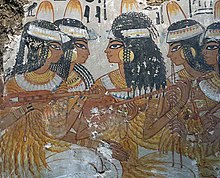 Lute and double pipe players from a mural found in the Theban tomb of Nebamun, a nobleman of the 18th Dynasty of the New Kingdom, c. 1350 BC
 Egyptian cuisine makes heavy use of legumes, vegetables and fruit from Egypt's rich Nile Valley and Delta. It shares similarities with the food of the Eastern Mediterranean region, such as rice-stuffed vegetables, grape leaves, shawerma, kebab and kofta.

Music has been an integral part of Egyptian culture since antiquity. The Bible documents the instruments played by the ancient Hebrews, all of which are correlated in Egyptian archaeology. Egyptian music probably had a significant impact on the development of ancient Greek music, and via the Greeks was important to early European music well into the Middle Ages. Egyptian modern music is considered as a main core of Middle Eastern and Oriental music as it has a very big influence on the region due to the popularity and huge influence of Egyptian Cinema and Music industries. The tonal structure of Oriental Middle Eastern music is defined by the maqamat, loosely similar to the Western modes, while the rhythm of Middle Eastern music is governed by the iqa'at, standard rhythmic modes formed by combinations of accented and unaccented beats and rests.
Lute and double pipe players from a mural found in the Theban tomb of Nebamun, a nobleman of the 18th Dynasty of the New Kingdom, c. 1350 BCEgyptian cuisine makes heavy use of legumes, vegetables and fruit from Egypt's rich Nile Valley and Delta. It shares similarities with the food of the Eastern Mediterranean region, such as rice-stuffed vegetables, grape leaves, shawerma, kebab and kofta.

Greenland
Territory
- Territory
Description
Greenland is the world's largest island, located between the Arctic and Atlantic oceans, east of the Canadian Arctic Archipelago. It is an autonomous territory within the Kingdom of Denmark TRADITIONS: The culture of Greenland has much in common with Greenlandic Inuit tradition, as the majority of people are descended from Inuit. Many people still go ice fishing and there are annual dog-sled races in which everyone with a team participates.
However, Greenland has now become somewhat of a tourist attraction. It holds contests to attract tourists such as dog racing, ice fishing, hiking, and cross country racing.
 Greenland clothing
- The Greenlandic language is roughly divided into four dialects: South Greenlandic, West Greenlandic, East Greenlandic and the Thule dialect. West Greenlandic is the official language which all children learn in addition to Danish and English. MUSIC: The music of Greenland is a mixture of two primary strands, Inuit and Danish, mixed with influences from the United States and United Kingdom. Greenland's musical character has been described as "definitely a rock country, both musically and literally" according to Greenlandic drummer Hans Rosenberg. CUISINE: The national dish of Greenland is suaasat, a traditional Greenlandic soup. It is often made from seal, or from whale, reindeer, or seabirds. The soup often .. RELIGION: The prevailing religion in Greenland is Protestantism and Greenland is an independent diocese in the Danish Evangelical Lutheran Church with a bishop appointed by Denmark.
REFLECTION:


- Greenland is the world's largest island, located between the Arctic and Atlantic oceans, east of the Canadian Arctic Archipelago. It is an autonomous territory within the Kingdom of Denmark TRADITIONS:
The culture of Greenland has much in common with Greenlandic Inuit tradition, as the majority of people are descended from Inuit. Many people still go ice fishing and there are annual dog-sled races in which everyone with a team participates.
However, Greenland has now become somewhat of a tourist attraction. It holds contests to attract tourists such as dog racing, ice fishing, hiking, and cross country racing.
Greenland clothing
- The Greenlandic language is roughly divided into four dialects: South Greenlandic, West Greenlandic, East Greenlandic and the Thule dialect. West Greenlandic is the official language which all children learn in addition to Danish and English. MUSIC: The music of Greenland is a mixture of two primary strands, Inuit and Danish, mixed with influences from the United States and United Kingdom. Greenland's musical character has been described as "definitely a rock country, both musically and literally" according to Greenlandic drummer Hans Rosenberg. CUISINE: The national dish of Greenland is suaasat, a traditional Greenlandic soup. It is often made from seal, or from whale, reindeer, or seabirds. The soup often .. RELIGION: The prevailing religion in Greenland is Protestantism and Greenland is an independent diocese in the Danish Evangelical Lutheran Church with a bishop appointed by Denmark.